Our current time zone: GMT +8 (We're home in Singapore!)
After spending the first few months of our trip eating our way through fastfood outlets and IHOPs in the US, and limited choices of local cuisine in the Caribbean, arriving in Colombia was like stepping into food paradise. While the range of local food can't be compared to the offerings in Singapore, it has kept me more than happy during our 2 weeks here in Bogota. Being able to sample a new food item everyday at a cheap price gives me something to look forward to after 3 hours of Spanish lessons.
Hostel Food
One of the first meals we had was in the hostel - a weekly Thursday night BBQ at COP 8,000 (US$4) per person. Eating off the table tennis table was a good opportunity to get to know our fellow hostel guests who hailed from Korea, England, America, etc. When it came to the food however, variety was limited to beef fillets, salted baked potatoes, grilled bananas and some guacamole. The staff were frantically tossing the meats on the grill and went into a fanning frenzy in order to feed the hungry guests. The beef got charred on the outside but was left raw on the inside. We didn't sign up for the BBQ held the following week.  Thursday night BBQs at the hostel
 Digging into our first hard-earned lunch at Don Rafa - sopa verdura, pollo, pasta y pina.
  Not much choice when it comes to soup - it's always veggie soup with a mixture of root veggies and lentils. My favourite is ajiaco - which, due to some herb in it, is more tasty than regular soup
 Set lunch at a restaurant in Zipaquira after visiting the Salt Cathedral. COP 6,000 (US$3) I had the fried chicken, which was REALLY good.
  Back at Don Rafa - our favourite eatery. I had the sobrebarriga asada as the choice of meat - roast beef (from the flank of the cow, literally "over the belly") Muy muy decliciosa!
 Arepa con chorizo. Arepas are small doughy pancakes made of white corn. Totally tasteless, so it's usually served as a side as part of a bigger meal.
  Banjera paisa - typically Bogotan. A massive serving of food comprising rice, minced beef, beans, an arepa, a chorizo sausage, a grilled banana, a slice of avocado and a huge slab of deep fried pork lard.
  Tamal - reminded me alot of our meat dumpings (bak chang or zhong zi) back home. Instead of rice, corn meal is used to enclose the meat (usually chicken) and is then wrapped in leaves and steamed. Absolutely yummy. We ate it, together with Vincent from Taiwan, and lamented about missing Dumpling Festival (held in July) back home in Asia.
  Chocolate Santefereño - a Colombian tradition. Hot chocolate served with a buttered bun, a puff pastry and slab of cheese. You dunk the cheese into the chocolate.
  Enjoying a simple set lunch at Pizza Poli - a slice of freshly-baked pizza and a drink for COP 4,400 (US$2.20)
 Donning guantes (gloves) for his oily meal - fried chicken, salted baked potatoes, fried bananas, and a drink (COP 5,000 or US$2.50)
 No fried chicken for me, thank you. I had pechunga a la plancha - grilled chicken breast for COP 6.000 (US$3) Also served with salted potatoes, fried banana and an arepa.
  Empanadas - similar to the curry puff, but the pastry is made of corn meal instead of flour. Filled with chicken, beef or veggies and eaten with a variety of dips. Empanadas with meat cost about COP 1,300 or US$0.65.
  This vendor was very proud of her Mickey Mouse wafers
 Choose from a selection of spreads - mora (raspberry jam), dulce de leche (sweetened milk), arequipa (caramel), queso (grated cheese) and peanuts.
  We chose mora, arequipa and dulce de leche, which are spread on a wafer and sandwiched with another.
  The buñuelo y avena combo for COP 2,000 (US$1)
 I don't know exactly what these are called - helatinas, I think. Basically sticks of marshmallow.
  This guy was doing a roaring business on Independence Day. We caved in and bought a soft-serve ice-cream, topped with chocolate sauce and rainbow sprinkles for COP 800 (US$0.40)
At Montserrat (which we will do a blog entry on later), we came across a market place where various open-air stalls were hawking local delicacies. We gave the intestine stews and scary-looking sausages a miss though. We saw some people spooning into some colourful red and white snacks, which turned out to be cheesy curd paired with your choice of mermalada (marmalade - a huge slab of it!) or arequipa.  Red and white - a new National Day snack for Singapore?
  A Swiss roll? Just after wiping out a super heavy lunch set at Zipaqueria.
  A whole bunch can fit into the palm of my hand!
 Queueing up for a cuppa at Juan Valdez - all prepared to place my order in Spanish
 The courtyard at Juan Valdez is a nice place to relax and people-watch - as long as you make your way back before dark.
  Is my cooking really THAT hard to eat?!
Eat on!
Haha... no, the we're not getting married again! But married life sure is great.The wife did something really sweet the other night. After I purchased my new camera, I was talking about getting a small pouch so that the LCD will not get scratched."No need", she said. "I'll make one for you tonight."So, while I was pulling my hair out while being totally frustrated with T-Mobile (and yet trying to be polite), she was going back to her Home Economics days. After a bit of snipping and sewing, look what she made! "Borrowed" the velcro from my old Olympus pouch
 She promised to wear only the remainder of her blue top when we visit our next nude beach
 It's like making a molehill out of a mountain!
Okay, enough doom and gloom in the last few entries. We're glad to introduce the nicer side of Bogota to the world. This entry was meant to be posted much earlier, but got superseded by all the bad stuff which happened, which is a shame. And since our readers back home are probably suffering the weekly bout of Monday blues today, we hope that this picture-heavy entry will bring some cheer to the start of your week. On one of the weekends in Bogota, we made a day trip to Zipaquira to visit La Catedral de Sal - literally "the Salt Cathedral". Together with our new Taiwanese friend, Vincent, we embarked on the first leg of the journey - a 40-minute ride on the Transmileno.The Transmileno is said to have revolutionised Bogota's public transport system. It's pretty much like our MRT back home, except that instead of overhead or underground tracks, the Transmileno buses run along designated lanes (a bit like our bus lanes) and instead of trains, passengers ride on bendy-buses. It costs COP 1,500 (approx US$0.75) per trip, regardless of time or distance traveled. The Transmileno bus-stops are not like anything we've seen before. They function like bus terminals where there are designated boarding points for different bus services, but are built like MRT stations, complete with platforms and sliding doors.  Inside one of the "bus-stops" for the Transmileno
 Somewhere over the rainbow lies our stop
 Meeting Vincent made us effectively multilingual - learning Spanish while conversing in English, Mandarin and a smattering of Hokkien.
  View of Bogota's city streets from inside the Transmileno. Picture taken by the Canon SX200 in "colour accent" mode. Muy cool.
 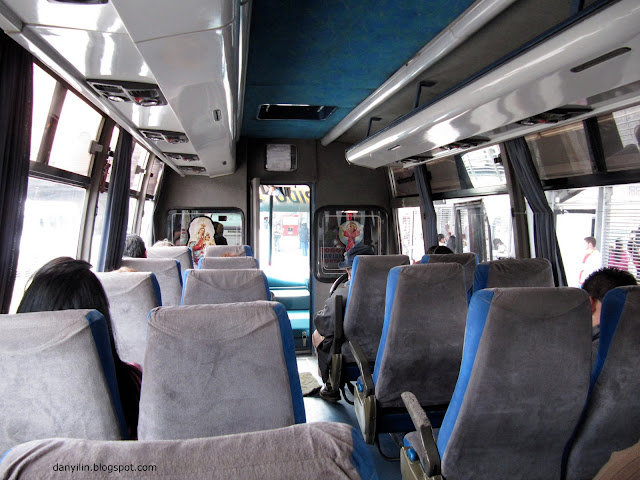 Going to Zipaquira on the inter-city bus
 Avocados are pretty popular side dishes in Colombian fare, eaten with a pinch of salt
 In front of a church that reminds me very much of a sandcastle
 Checking out local wares - steaming hot tamales, crepes, soups, pastries, etc.
 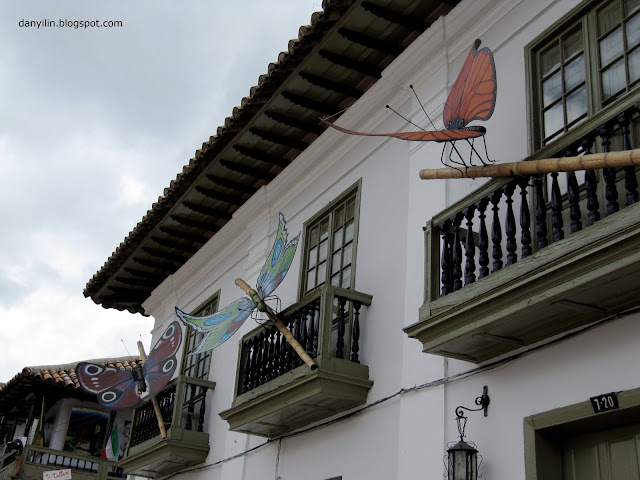 The Colombians in Zipaquira have quite a sense of humour when choosing decorations for their building facades. Giant butterflies here...
 ... a colony of leaf-cutter ants covering another building...
 ... and a heated stand-off between a steely bull and a wiry man here.
  Stopping, gawking and snapping every few steps. The expression on my face tells Dan that he's taking way too many pictures here.
  Uphill from the Zipaquira town centre, near the entrance to the salt mines
 All set to go deep down, 180m underground
The route through the tunnels is said to prepare the pilgrim as he transcends from an external, material world into a conceptual, interior world. From the terrastrial, to the spiritual. As we told Vincent, in a language he's familiar with, "si beh cheem ah."
 Light eminating from the crucifix carved into the wall
 Trying out the stone-hard pews.... oww
 Many of the crosses are really big. This one seems to be rising from the skies, bathed in heavenly light
 The biggest cross of all, seen from afar. You can see tiny human-shapes in front of it. A trumpeter angel carved in stone stands out against the lurid green background.
  Angels we have heard on high
 Away in the manger, no crib for a bed
 You can see the softness in the angel's wings, hair and robes despite it being carved out of hard mineral. Lovely.
  The blessed babe watched over by angels
 Having a quiet moment
 The pillars supporting the roof of the cathedral are so HUGE and perfectly symmetrical
 Freshly brewed Colombian coffee served in a cave
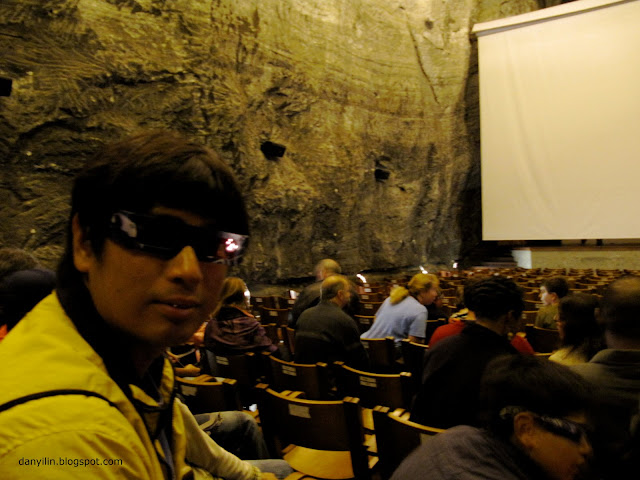 We may have missed Ice Age 3 and Up but we still got to watch a 3D movie on this trip
 Living life with a pinch of salt
 Thursday night BBQs at the hostel
 Digging into our first hard-earned lunch at Don Rafa - sopa verdura, pollo, pasta y pina.
  Not much choice when it comes to soup - it's always veggie soup with a mixture of root veggies and lentils. My favourite is ajiaco - which, due to some herb in it, is more tasty than regular soup
 Set lunch at a restaurant in Zipaquira after visiting the Salt Cathedral. COP 6,000 (US$3) I had the fried chicken, which was REALLY good.
  Back at Don Rafa - our favourite eatery. I had the sobrebarriga asada as the choice of meat - roast beef (from the flank of the cow, literally "over the belly") Muy muy decliciosa!
 Arepa con chorizo. Arepas are small doughy pancakes made of white corn. Totally tasteless, so it's usually served as a side as part of a bigger meal.
  Banjera paisa - typically Bogotan. A massive serving of food comprising rice, minced beef, beans, an arepa, a chorizo sausage, a grilled banana, a slice of avocado and a huge slab of deep fried pork lard.
  Tamal - reminded me alot of our meat dumpings (bak chang or zhong zi) back home. Instead of rice, corn meal is used to enclose the meat (usually chicken) and is then wrapped in leaves and steamed. Absolutely yummy. We ate it, together with Vincent from Taiwan, and lamented about missing Dumpling Festival (held in July) back home in Asia.
  Chocolate Santefereño - a Colombian tradition. Hot chocolate served with a buttered bun, a puff pastry and slab of cheese. You dunk the cheese into the chocolate.
  Enjoying a simple set lunch at Pizza Poli - a slice of freshly-baked pizza and a drink for COP 4,400 (US$2.20)
 Donning guantes (gloves) for his oily meal - fried chicken, salted baked potatoes, fried bananas, and a drink (COP 5,000 or US$2.50)
 No fried chicken for me, thank you. I had pechunga a la plancha - grilled chicken breast for COP 6.000 (US$3) Also served with salted potatoes, fried banana and an arepa.
  Empanadas - similar to the curry puff, but the pastry is made of corn meal instead of flour. Filled with chicken, beef or veggies and eaten with a variety of dips. Empanadas with meat cost about COP 1,300 or US$0.65.
  This vendor was very proud of her Mickey Mouse wafers
 Choose from a selection of spreads - mora (raspberry jam), dulce de leche (sweetened milk), arequipa (caramel), queso (grated cheese) and peanuts.
  We chose mora, arequipa and dulce de leche, which are spread on a wafer and sandwiched with another.
  The buñuelo y avena combo for COP 2,000 (US$1)
 I don't know exactly what these are called - helatinas, I think. Basically sticks of marshmallow.
  This guy was doing a roaring business on Independence Day. We caved in and bought a soft-serve ice-cream, topped with chocolate sauce and rainbow sprinkles for COP 800 (US$0.40)
  Red and white - a new National Day snack for Singapore?
  A Swiss roll? Just after wiping out a super heavy lunch set at Zipaqueria.
  A whole bunch can fit into the palm of my hand!
 Queueing up for a cuppa at Juan Valdez - all prepared to place my order in Spanish
 The courtyard at Juan Valdez is a nice place to relax and people-watch - as long as you make your way back before dark.
  Is my cooking really THAT hard to eat?!