Okay, here's another video with footage from Ecuador. The wife might have thought that she closed the chapter on Ecuador a couple of posts ago, but I'm not done yet!
Please, enjoy looking at my birdies! :)
Note: I wish the video quality was better, but Youtube blocked the audio for this video because it did not have pre-arranged rights to host this song. Blogger allows it, but video quality suffers. Sigh.
Showing posts with label Puerto Lopez. Show all posts
Showing posts with label Puerto Lopez. Show all posts
Friday, September 18, 2009


Sunday, September 6, 2009
Boobie Wonderland
Hi! I'm a blue-footed booby from Ecuador and I'm going to be your fine-feathered guest blogger for this entry.
The boy-owner of this blog was quite excited about writing this post. As expected, he wanted to put in all sorts of corny puns about boobies (not the feathered kind.) The girl-owner thought she could do a better job, starting with "My First Booby" as a title and linking it to her memory of "My First Barbie" (How lame!) Well thank goodness she didn't insist on writing it - just look at her first blog entry on birds! I'm glad that they finally came to their senses and decided that I would be the bestperson bird to show you some real bird talk!
 That's me - your feathered host for this fabulous blog entry - sitting in my nest. The male booby (mooby?) is my husband. Doesn't he have the most gorgeous blue feet ever?
We live on a small island (7km by 2km) in the Pacific Ocean, just off the coast of Ecuador. Our home was named Isla de la Plata or "Silver Island" for 2 reasons. Firstly, it is rumoured that Sir Francis Drake (the first Englishman to circumvent the globe) buried his treasure here and secondly, the thick layers of guano caking the cliffs give off a lovely silver aura (and aroma) under the sun's rays! As you can tell, I prefer the second explanation on how the Silver Island got it's name (oh, the sense of puffy-chested pride that we birds get from this honour!)
 Where we live. I think the cliffs are losing their shine - they need a fresh coat of dazzling guano!
Most tourists visit Isla de la Plata as part of a whalewatching tour. Why these fat blubbery mammals (that look like fish... how weird!) get to be the main attraction of the tour - by entertaining tourists with their cheap antics (like squirting water from those huge nostrils located on top of their heads!) before and after the visit to our island (show stealers!), is a mystery to me. Humph.
The people who come are usually poor souls who can't afford the money or the time for a full-blown Galapagos Islands tour. US$40 (plus US$15 more for the national park fee) gets you a few whale sightings (big fat hairy deal, if you ask us birds!), speedboat transfers to and from Isla de la Plata, a guided tour of the island, rental of masks and snorkels, and a box lunch (watermelon, pineapple, tuna and cheese sandwiches, and Coke.) In comparison, a week-long Galapagos tour would set you back by US$3,000. It's no wonder that our little island has been christened "the poor man's Galapagos"! We don't suffer from any inferiority complex though - our feet are as blue as those of our Galapagos-born cousins!
 Yellow-breasted Chinaman. Loved the way he smiled till his eyes disappeared into his head. How did he do that?!
Upon arrival at Isla de la Plata, the guide briefs the guests on the location of our colonies on the island. Guests are given 2 options: to take longer uphill climb where they can see blue-footed boobies, albatross, some other white bird (I forgot it's name) and sealions. Or the shorter, gentler path to see red-footed and blue-footed boobies, frigatebirds and er, one more less interesting bird. However, as the guide kindly highlights, more species of birds can be sighted on the shorter route, whereas guests only have a 10% chance of spotting an albatross or sealion on the longer one. Plus, the sooner the group returns to the boat, the more time everyone would have for snorkeling. How sly. Most tourists are happy to go with the shorter trek anyway.
 I'm at No.7! But we're also found along the other (red & green) path
 Tee hee. Bird watching humans go birdwatching!
 The view from my apartment. Isn't it lovely?
So, I guess everyone wants to know why we have blue feet. Gee, I don't know! Wouldn't it be tiresome if every animal you met asked you why humans have 10 fingers and 10 toes which only come in various shades of brown? I guess that at the end of his 5th day at work, God got tired of making thousands of yellow bird-feet and decided to have some fun with the leftover blue paint that he used to create the sky!
Well, we female boobies really, and I mean really, like blue feet. So much so that we only mate with males with those big, blue and handsome tootsies. The bluer the feet, the faster our hearts beat for the male. Otherwise, how are we suppose to guarantee that our offspring will have blue feet? It's all in the blue genes (haha, like blue jeans, geddit, geddit?)
We reproduce once a year, churning out an average of 1 to 3 chicks per brood. Our babies are born snowy white, without a single speck of blue on them. Their feet start turning blue when they are a few months old (nothing to panic about when your baby turns blue, Mothers!)
Female boobies are bigger in size (we like our women big) and appear to have larger pupils than male boobies (er, moobies?)
 "What's your problem, humankind? Have you never seen blue feet before?"
 Guarding the dressing-room. "You can't go in there, my husband's changing his shoes to... his other blue pair."
 The problem with all male animals (humans included): "Darling! What in god's name are you doing? That's unglam! We're on camera, for goodness sake!"
To prove my point, here are some other snippets from our daily lives to illustrate our intelligence:
 "Hmmm, there's so much guano around my rock. Wonder how it got there..."
 "Arrggghh, yucks yucks!! I stepped on guano, I stepped on guano! Must..try...to...flick...it...off!! Oh wait... it's mine."
 Taking off with your feet in front?! Clumsy fella!
 "Yeah. So I'm stepping on my own feet. You have a problem with that, huh? Quit staring."
When we boobies are in love, we engage in an endearing display of courtship. I hereby share some love tips with you, in the sincere hope that they will help improve your love life too.
Step 1: Clack beaks
Step 2: Show off your spanking blue feet with a high-stepping strut
Step 3: Raise your wings and point your beak towards the sky
Step 4: Repeat
To the girls out there, remember to relax and let the guy take the lead in impressing you. Only if you like him, do you mimic his actions.
 "Not now, dear. There are people watching!"
 "Hey dude, it's not the Macarena! But thanks for trying to learn our mating dance. A word of advice - get blue footwear. The babes like 'em in blue." *wink*
 "Pssst! No one's watching us behind these bushes. Mate with me, baby, mate with me now!"
You may have heard tales of our intense sibling rivalry, to the extent of sibling murder, from sources such as Sir David Attenborough, BBC, Animal Planet, National Geographic and Discovery Channel. As their story goes, the first chick hatches a few days before the others. Thus, it starts receiving food first and gets a headstart on the growth process. When its younger siblings finally hatch, the larger and stronger first-born chick outcompetes them for food, deliberately starving the others to death.
At the time of hatching, the nest is surrounded by a ring of guano, which is created by squirting our poop in all directions (I know, I know, it sounds disgusting.) If murder by starvation doesn't work (or it takes waaaay too long), the first-born chick will shove its weaker siblings outside of the ring. I don't really know why, but this totally freaks us parents out and we will promptly disown any of our brood who have crossed the guano-line. It's as if Mother Nature imposed a "One Is Enough" rule on our species.
 That chick is just a few months old. Huge, isn't it? Imagine if your human babies grew to your height within a few months of their birth. Freaky beaky!
 Looking for Mummy
Oh, look how I've dominated this online tour of Isla de la Plata with info about us boobies only.
Let us move on to a short overview of thebig-breasted big-chested frigatebirds, or fregatas.
Unlike the boobies who like to walk around and nest on the ground, the frigatebirds prefer to hang around in the trees.
 We like humans as long as they behave themselves on our island. We let them get pretty close to us. And we smile for pictures too!
The ones on the island are the Magnificent or Man O'War Frigatebirds. The males have inflatable red throat pouches called "gular-pouches" which they inflate to attract females. Just like how a male human presents a red shiny heart-shaped balloon to the girl he wants! Sometimes, these male frigatebirds inflate their chests so large that they can hardly see straight. In my hum-blue opinion, they look mightily uncomfortable.
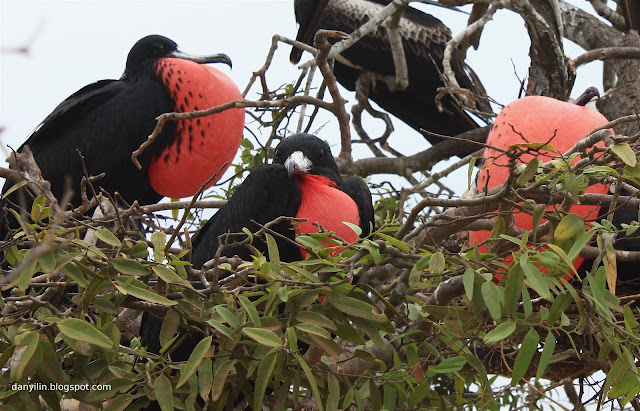 Sure, you guys have the big breasts but I'm the real booby here!
Despite their penchant for showing off, we boobies get along well with our puffy-chested neighbours. But thank goodness we don't get along that well. Just imagine what would happen if our kind were to mate with theirs... blue-footed fregatas, or freboobies!
 Red chest and blue feet? Oh the horror!!
Throughout the tour, our guests were tailed closely by a couple of LBBs (Little Brown Birds) as they explored the island. The LBBs would rudely interrupt their conversations with a loud "peep!" My guess would be that these mockingbirds were trying to imitate human conversations and get their 2-cents-worth in! Mockingbirds have a huge memory bank of songs - of other people's songs - just like your iPod. They can recall and copy the songs of up to 200 birds, insects and amphibians! These music geniuses are reported to have mimicked the sounds of children crying even! So I wouldn't put it past them to mock these humans by trying to copy snippets of their conversations.
 It's really hard to worm a smile out of Mr Grumpy!
 And I heard her call ME funny. Seriously, some people should take a look in the mirror.
 I don't visit the folks from the underwater world too often. I only go diving when I'm hungry for anchovies! So I'm not too familiar with these big guys here. Anyone know what species of fish they are?
And with that, our guests from Puerto Lopez were done for the day! Just before the tour ended, the Singaporean guy came up to me and whispered, "Thank you for being my first booby." What a strange thing to say! Well, my pleasure, dear boy, my pleasure.
 Another satisfied customer
People always tell me that they love visiting Ecuador. But when asked what they like best about my country, they name everything from the sun to the moon - the birds, the whales, the people, the Andes, the Amazon, the Pacific coast. If you can't put your finger on a single best reason for falling in love with this beautiful place, here's my advice to you:
The boy-owner of this blog was quite excited about writing this post. As expected, he wanted to put in all sorts of corny puns about boobies (not the feathered kind.) The girl-owner thought she could do a better job, starting with "My First Booby" as a title and linking it to her memory of "My First Barbie" (How lame!) Well thank goodness she didn't insist on writing it - just look at her first blog entry on birds! I'm glad that they finally came to their senses and decided that I would be the best
 That's me - your feathered host for this fabulous blog entry - sitting in my nest. The male booby (mooby?) is my husband. Doesn't he have the most gorgeous blue feet ever?
We live on a small island (7km by 2km) in the Pacific Ocean, just off the coast of Ecuador. Our home was named Isla de la Plata or "Silver Island" for 2 reasons. Firstly, it is rumoured that Sir Francis Drake (the first Englishman to circumvent the globe) buried his treasure here and secondly, the thick layers of guano caking the cliffs give off a lovely silver aura (and aroma) under the sun's rays! As you can tell, I prefer the second explanation on how the Silver Island got it's name (oh, the sense of puffy-chested pride that we birds get from this honour!)
 Where we live. I think the cliffs are losing their shine - they need a fresh coat of dazzling guano!
Most tourists visit Isla de la Plata as part of a whalewatching tour. Why these fat blubbery mammals (that look like fish... how weird!) get to be the main attraction of the tour - by entertaining tourists with their cheap antics (like squirting water from those huge nostrils located on top of their heads!) before and after the visit to our island (show stealers!), is a mystery to me. Humph.
The people who come are usually poor souls who can't afford the money or the time for a full-blown Galapagos Islands tour. US$40 (plus US$15 more for the national park fee) gets you a few whale sightings (big fat hairy deal, if you ask us birds!), speedboat transfers to and from Isla de la Plata, a guided tour of the island, rental of masks and snorkels, and a box lunch (watermelon, pineapple, tuna and cheese sandwiches, and Coke.) In comparison, a week-long Galapagos tour would set you back by US$3,000. It's no wonder that our little island has been christened "the poor man's Galapagos"! We don't suffer from any inferiority complex though - our feet are as blue as those of our Galapagos-born cousins!
 Yellow-breasted Chinaman. Loved the way he smiled till his eyes disappeared into his head. How did he do that?!
Upon arrival at Isla de la Plata, the guide briefs the guests on the location of our colonies on the island. Guests are given 2 options: to take longer uphill climb where they can see blue-footed boobies, albatross, some other white bird (I forgot it's name) and sealions. Or the shorter, gentler path to see red-footed and blue-footed boobies, frigatebirds and er, one more less interesting bird. However, as the guide kindly highlights, more species of birds can be sighted on the shorter route, whereas guests only have a 10% chance of spotting an albatross or sealion on the longer one. Plus, the sooner the group returns to the boat, the more time everyone would have for snorkeling. How sly. Most tourists are happy to go with the shorter trek anyway.
 I'm at No.7! But we're also found along the other (red & green) path
 Tee hee. Bird watching humans go birdwatching!
 The view from my apartment. Isn't it lovely?
 So, I guess everyone wants to know why we have blue feet. Gee, I don't know! Wouldn't it be tiresome if every animal you met asked you why humans have 10 fingers and 10 toes which only come in various shades of brown? I guess that at the end of his 5th day at work, God got tired of making thousands of yellow bird-feet and decided to have some fun with the leftover blue paint that he used to create the sky!
Well, we female boobies really, and I mean really, like blue feet. So much so that we only mate with males with those big, blue and handsome tootsies. The bluer the feet, the faster our hearts beat for the male. Otherwise, how are we suppose to guarantee that our offspring will have blue feet? It's all in the blue genes (haha, like blue jeans, geddit, geddit?)
We reproduce once a year, churning out an average of 1 to 3 chicks per brood. Our babies are born snowy white, without a single speck of blue on them. Their feet start turning blue when they are a few months old (nothing to panic about when your baby turns blue, Mothers!)
Female boobies are bigger in size (we like our women big) and appear to have larger pupils than male boobies (er, moobies?)
 "What's your problem, humankind? Have you never seen blue feet before?"
 Guarding the dressing-room. "You can't go in there, my husband's changing his shoes to... his other blue pair."
 The problem with all male animals (humans included): "Darling! What in god's name are you doing? That's unglam! We're on camera, for goodness sake!"
Given that life is all about our iconic feet, why in the world are we called "boobies?" Apparently, the European conquistadors mistook our innocence and trust in our human captors for stupidity! So they called us "bobo", which is Spanish for "clown" or "stupid". I find that highly offensive! As if it's not rude enough to equate us to mammaries! Our friendly Ecuadorian neighbours are a nicer lot, and politely call us by the local name "piquero", meaning "lancer" in Spanish, in recognition of our long pointed beaks.
Just watch this brilliant video of us. Do we look at all stupid to you?
Just watch this brilliant video of us. Do we look at all stupid to you?
To prove my point, here are some other snippets from our daily lives to illustrate our intelligence:
 "Hmmm, there's so much guano around my rock. Wonder how it got there..."
 "Arrggghh, yucks yucks!! I stepped on guano, I stepped on guano! Must..try...to...flick...it...off!! Oh wait... it's mine."
 Taking off with your feet in front?! Clumsy fella!
 "Yeah. So I'm stepping on my own feet. You have a problem with that, huh? Quit staring."
When we boobies are in love, we engage in an endearing display of courtship. I hereby share some love tips with you, in the sincere hope that they will help improve your love life too.
Step 1: Clack beaks
Step 2: Show off your spanking blue feet with a high-stepping strut
Step 3: Raise your wings and point your beak towards the sky
Step 4: Repeat
To the girls out there, remember to relax and let the guy take the lead in impressing you. Only if you like him, do you mimic his actions.
 "Not now, dear. There are people watching!"
 "Hey dude, it's not the Macarena! But thanks for trying to learn our mating dance. A word of advice - get blue footwear. The babes like 'em in blue." *wink*
 "Pssst! No one's watching us behind these bushes. Mate with me, baby, mate with me now!"
You may have heard tales of our intense sibling rivalry, to the extent of sibling murder, from sources such as Sir David Attenborough, BBC, Animal Planet, National Geographic and Discovery Channel. As their story goes, the first chick hatches a few days before the others. Thus, it starts receiving food first and gets a headstart on the growth process. When its younger siblings finally hatch, the larger and stronger first-born chick outcompetes them for food, deliberately starving the others to death.
At the time of hatching, the nest is surrounded by a ring of guano, which is created by squirting our poop in all directions (I know, I know, it sounds disgusting.) If murder by starvation doesn't work (or it takes waaaay too long), the first-born chick will shove its weaker siblings outside of the ring. I don't really know why, but this totally freaks us parents out and we will promptly disown any of our brood who have crossed the guano-line. It's as if Mother Nature imposed a "One Is Enough" rule on our species.
 That chick is just a few months old. Huge, isn't it? Imagine if your human babies grew to your height within a few months of their birth. Freaky beaky!
  Looking for Mummy
Oh, look how I've dominated this online tour of Isla de la Plata with info about us boobies only.
Let us move on to a short overview of the
Unlike the boobies who like to walk around and nest on the ground, the frigatebirds prefer to hang around in the trees.
 We like humans as long as they behave themselves on our island. We let them get pretty close to us. And we smile for pictures too!
The ones on the island are the Magnificent or Man O'War Frigatebirds. The males have inflatable red throat pouches called "gular-pouches" which they inflate to attract females. Just like how a male human presents a red shiny heart-shaped balloon to the girl he wants! Sometimes, these male frigatebirds inflate their chests so large that they can hardly see straight. In my hum-blue opinion, they look mightily uncomfortable.
 Sure, you guys have the big breasts but I'm the real booby here!
Despite their penchant for showing off, we boobies get along well with our puffy-chested neighbours. But thank goodness we don't get along that well. Just imagine what would happen if our kind were to mate with theirs... blue-footed fregatas, or freboobies!
 Red chest and blue feet? Oh the horror!!
Throughout the tour, our guests were tailed closely by a couple of LBBs (Little Brown Birds) as they explored the island. The LBBs would rudely interrupt their conversations with a loud "peep!" My guess would be that these mockingbirds were trying to imitate human conversations and get their 2-cents-worth in! Mockingbirds have a huge memory bank of songs - of other people's songs - just like your iPod. They can recall and copy the songs of up to 200 birds, insects and amphibians! These music geniuses are reported to have mimicked the sounds of children crying even! So I wouldn't put it past them to mock these humans by trying to copy snippets of their conversations.
 It's really hard to worm a smile out of Mr Grumpy!
Despite their irritating habit of mocking us by mimicking our songs (if you can call my nasal honk a song), the mockingbird is one harmless creature. Like one of the characters in Harper Lee's To Kill A Mockingbird says:
"Mockingbirds don't do one thing but make music for us to enjoy. They don't eat up people's gardens, don't nest in corncribs, they don't do one thing but sing their hearts out for us. That's why it's a sin to kill a mockingbird."
Walking around the island to visit me and my neighbours seemed to get our human guests all hot and bothered. Many of them were dying for a swim in the clear waters at the foot of the cliffs. I'm not a fan of snorkeling, but I hear that the fish living in the coral reefs off Isla de la Plata are much larger than those seen in other parts of the world. Someone mentioned that the parrotfish there were big enough to feed a family of four!
 And I heard her call ME funny. Seriously, some people should take a look in the mirror.
 I don't visit the folks from the underwater world too often. I only go diving when I'm hungry for anchovies! So I'm not too familiar with these big guys here. Anyone know what species of fish they are?
 And with that, our guests from Puerto Lopez were done for the day! Just before the tour ended, the Singaporean guy came up to me and whispered, "Thank you for being my first booby." What a strange thing to say! Well, my pleasure, dear boy, my pleasure.
 Another satisfied customer
People always tell me that they love visiting Ecuador. But when asked what they like best about my country, they name everything from the sun to the moon - the birds, the whales, the people, the Andes, the Amazon, the Pacific coast. If you can't put your finger on a single best reason for falling in love with this beautiful place, here's my advice to you:
Don't blame it on sunshineAnd with that, it's been a pleasure being your host for this post. From Isla de la Plata, it's over and out *nasal honk*
Don't blame it on moonlight
Don't blame it on good times
Blame it on the BOOBIES!
Saturday, September 5, 2009
Having A Whale Of A Time
When I was 10, my parents brought us kids to SeaWorld San Diego where I met a back-flipping killer whale named Shamu. I went home with a Talking Shamu cuddly toy (well, not very cuddly cos of the battery-operated speaker in his tummy) as a souvenir of the celebrity whale.
Just recently, I was talking to a friend about SeaWorld and she mentioned Shamu. Yups, that whale is an eternal celebrity, although I've no idea how many killer whales have been named Shamu since (and before) we visited SeaWorld in 1990.
The closest I've come to seeing another whale since then was when I watched the movie Free Willy and BBC's awesome nature documentaries, Deep Blue and The Galapagos Islands, on Blu-Ray. Snorkeling with a whaleshark in the Maldives does not count, because although whalesharks are incredibly huge creatures too and look alot like whales, they are actually fish. And not the warm-blooded live-bearing mammals that whales are.
Off the Pacific Coast of South America around the tropical belt, whale sightings are practically guaranteed from July to September every year when the whales gather to mate during the summer. At the fishing town of Puerto Lopez on the Ecuadorian coast, we went on a whalewatching tour that promised sightings of humpback whales. It was then that I saw my first (and second, and third, and fourth, and...) whale that was not a Shamu.
But first, I had to suffer some cruel pranks by The Boy Who Cried Whale:
 Please meet The Boy Who Cried Whale
Try going for a whalewatching tour with a character like this. I was already perched on the edge of my seat nervously clutching my camera, which was glued to my eye, all ready to spring to the other side of the boat at the glimpse of a dorsal fin. He took great joy in pointing in random directions (usually right behind my head) and dramatically gasping "LOOK!" at non-existent whales. And I would fall for it every time. Right up to the point when the boat pulled back up onto shore, signifying the end of the tour. And as the moral of the story goes, The Boy Who Cried Whale got his just desserts and got swallowed up by a whale.
Okay, no he didn't. He just got assigned laundry duty for the rest of this trip.
We got off on a really good start on the tour. Within minutes of leaving the beach in a zippy little speedboat, we spotted our first humpback whale when it leapt high into the air and landed back in the water with a tremendous splash. Apparently, it's not known for sure why whales breach in this way. Most observers agree that it's not solely for fun, as it takes a tremendous amount of energy for a whale to displace tonnes of body weight in order to rise out of the water, just for laughs. One can guess that the leaps are a form of communication (gawd, imagine having to somersault instead of sending a text message) or an impressive show of prowess.
Whatever the reason, the incredible display sure impressed the socks off me!
 Wanna fly as high as the birds? All you need is some whalepower!
The silvery misty curtains of Ecuador's cloud forests rising from the coast made for a beautiful stage for the whales' graceful performances.
 Aaaaahh... nothing like whaling away the afternoon in the ocean
 This guy was whaling to leap for my camera
This is my all-time favourite photo from the trip. I love the graceful arch of the whale's torso, the white flash of its striated belly and the watery curtains that drape from those knobbly fins.
 The most powerful jumper of all. Indeed he is the prince of whales.
These energetic gymnasts seemed to perform solo, bathing in the limelight of an appreciative human audience. We also saw small groups of whales, usually in pairs or a pod of 3, but these just swam uneventfully alongside the boat. Or rather, our boat had to play catch-up with them while their powerful tails and fins propelled them stealthily through the water. Throughout the tour, the boats never chased down the whales or got too close to the animals - something which I really appreciated. When scuba diving, the sound of a motorboat whizzing past above my head freaks me out a bit (the ear-busting sound of the grinding motor is many times louder when you're underwater) so I can imagine that it must be just as unpleasant for the whales if boats get too close.
 The humpbacks of Ecuador
 Finding yourself in deep waters? Don't fret. Al-whales look on the bright side of life!
 Trying to play 'Where's Whaley' with us
 Whales are mammals. So they need to come up to breathe once in a whale.
 Thar she blows!
I was in awe of these huge gentle creatures and absolutely honoured to be in their close presence. It was almost surreal to have witnessed these giants leaping powerfully into the air. My photos alone don't quite do justice to their magnificent displays. I fell asleep that night replaying the visions of those spectacular leaps in my head, trying to commit them to memory before they got fainter with each passing day.
 My photos prove that this fantastic experience was for real, and not just a whale of a tale!
I think I fell asleep with a big smile plastered all over my face that night :)
 Oh no, don't go! When whale I see you again?
 Bye! I'm sure whale meet again!
I'm glad that the whalewatching tour from Puerto Lopez was reasonably-priced (USD40 inclusive of lunch and a fantastic island tour - more of that in another blog entry) and that we could afford it, given our tight travel budget. With most whalewatching tours priced much higher than this, I don't know when our next chance to revel in such an awesome display of grace and power will be. But I know for sure, that this won't be our first and last meeting with the whales.
After all, if there's a whale, there's a way ;)
PS: Some of the terribly bad whale puns are courtesy of Dan, whom I married for his corny sense of humour (and a shiny ring.) And if you think our puns are bad, wait till you read these fish jokes. Some of the authors deserve to be krilled!
Just recently, I was talking to a friend about SeaWorld and she mentioned Shamu. Yups, that whale is an eternal celebrity, although I've no idea how many killer whales have been named Shamu since (and before) we visited SeaWorld in 1990.
The closest I've come to seeing another whale since then was when I watched the movie Free Willy and BBC's awesome nature documentaries, Deep Blue and The Galapagos Islands, on Blu-Ray. Snorkeling with a whaleshark in the Maldives does not count, because although whalesharks are incredibly huge creatures too and look alot like whales, they are actually fish. And not the warm-blooded live-bearing mammals that whales are.
Off the Pacific Coast of South America around the tropical belt, whale sightings are practically guaranteed from July to September every year when the whales gather to mate during the summer. At the fishing town of Puerto Lopez on the Ecuadorian coast, we went on a whalewatching tour that promised sightings of humpback whales. It was then that I saw my first (and second, and third, and fourth, and...) whale that was not a Shamu.
But first, I had to suffer some cruel pranks by The Boy Who Cried Whale:
 Please meet The Boy Who Cried Whale
 Try going for a whalewatching tour with a character like this. I was already perched on the edge of my seat nervously clutching my camera, which was glued to my eye, all ready to spring to the other side of the boat at the glimpse of a dorsal fin. He took great joy in pointing in random directions (usually right behind my head) and dramatically gasping "LOOK!" at non-existent whales. And I would fall for it every time. Right up to the point when the boat pulled back up onto shore, signifying the end of the tour. And as the moral of the story goes, The Boy Who Cried Whale got his just desserts and got swallowed up by a whale.
Okay, no he didn't. He just got assigned laundry duty for the rest of this trip.
We got off on a really good start on the tour. Within minutes of leaving the beach in a zippy little speedboat, we spotted our first humpback whale when it leapt high into the air and landed back in the water with a tremendous splash. Apparently, it's not known for sure why whales breach in this way. Most observers agree that it's not solely for fun, as it takes a tremendous amount of energy for a whale to displace tonnes of body weight in order to rise out of the water, just for laughs. One can guess that the leaps are a form of communication (gawd, imagine having to somersault instead of sending a text message) or an impressive show of prowess.
Whatever the reason, the incredible display sure impressed the socks off me!
 Wanna fly as high as the birds? All you need is some whalepower!
The silvery misty curtains of Ecuador's cloud forests rising from the coast made for a beautiful stage for the whales' graceful performances.
 Aaaaahh... nothing like whaling away the afternoon in the ocean
On other occasions, the whales chose Puerto Lopez's sandy cliffs as a backdrop.
 This guy was whaling to leap for my camera
This is my all-time favourite photo from the trip. I love the graceful arch of the whale's torso, the white flash of its striated belly and the watery curtains that drape from those knobbly fins.
 The most powerful jumper of all. Indeed he is the prince of whales.
 These energetic gymnasts seemed to perform solo, bathing in the limelight of an appreciative human audience. We also saw small groups of whales, usually in pairs or a pod of 3, but these just swam uneventfully alongside the boat. Or rather, our boat had to play catch-up with them while their powerful tails and fins propelled them stealthily through the water. Throughout the tour, the boats never chased down the whales or got too close to the animals - something which I really appreciated. When scuba diving, the sound of a motorboat whizzing past above my head freaks me out a bit (the ear-busting sound of the grinding motor is many times louder when you're underwater) so I can imagine that it must be just as unpleasant for the whales if boats get too close.
 The humpbacks of Ecuador
  Finding yourself in deep waters? Don't fret. Al-whales look on the bright side of life!
  Trying to play 'Where's Whaley' with us
 Whales are mammals. So they need to come up to breathe once in a whale.
  Thar she blows!
I was in awe of these huge gentle creatures and absolutely honoured to be in their close presence. It was almost surreal to have witnessed these giants leaping powerfully into the air. My photos alone don't quite do justice to their magnificent displays. I fell asleep that night replaying the visions of those spectacular leaps in my head, trying to commit them to memory before they got fainter with each passing day.
 My photos prove that this fantastic experience was for real, and not just a whale of a tale!
I think I fell asleep with a big smile plastered all over my face that night :)
 Oh no, don't go! When whale I see you again?
 Bye! I'm sure whale meet again!
I'm glad that the whalewatching tour from Puerto Lopez was reasonably-priced (USD40 inclusive of lunch and a fantastic island tour - more of that in another blog entry) and that we could afford it, given our tight travel budget. With most whalewatching tours priced much higher than this, I don't know when our next chance to revel in such an awesome display of grace and power will be. But I know for sure, that this won't be our first and last meeting with the whales.
After all, if there's a whale, there's a way ;)
PS: Some of the terribly bad whale puns are courtesy of Dan, whom I married for his corny sense of humour (and a shiny ring.) And if you think our puns are bad, wait till you read these fish jokes. Some of the authors deserve to be krilled!
Subscribe to:
Posts (Atom)
Forever Living

Read about the products, then contact our wellness sponsor!