We've been traveling for 8 months now and almost every single day, we take our cameras out with us and photograph our journey along the way.
Back home, I'm not one who totes around a small digicam in my handbag. So this is the longest time that I've had a camera stuck on me almost 24/7. (Who knows, I might just get addicted to having a camera on hand, even when I revert to my real life and clockwork routine *yawn*) Many times a day, I find myself assessing the environment and wondering whether to whip out the camera (which is in reality, a rather cumbersome combination of neck straps, bag straps, clips and zips) to snap a photo.
The natural scenery that we come across on our trip is simply awe-inspiring and magical - it really doesn't take much to capture the beauty of a place. We try to do more than just snap a conventional photo, which really doesn't convey more than "been there, done that". We explore new angles, toggle with shutter speeds, tweak exposure settings. But fatigue and boredom do set in. I get bored with the photos I take when they start looking the same - same style, same angle, same textures, same feel. Sometimes, I literally cannot tell the difference between one lake photo and another. It's the same with photos of mountains.
That's when you start losing inspiration, thinking "it's just another lake", "it's just a building", "it's just the city". Then you get lazy and find all sorts of excuses not make the effort to get a good photo. Too crowded. Too hot. Too troublesome. Too dangerous. Too rainy. Too dark. Too bright. Too tired. The sun is not in the right position. My camera sucks. My lens is too wide. My lens can't zoom so far. And so on.
And sometimes, in trying to get that perfect photo, we forget to have fun with the camera!
While in Ushuaia, Dan recalled taking a picture of a porcupine fish while diving in Lembeh (Indonesia) a couple of years ago. Trying desperately to focus on the puffer, which was merrily sailing past his eyes while the current was sweeping us forward, he trained his camera on the subject and snapped - while both man and fish were still moving. The result - a small wide-eyed ball of spikes looking as if it was high on Speed and blasting light years into space!
Our friend Sue Anne commented on Facebook: "Oh i like this! A little lone fish struggling to keep up in the mad rush hour...kinda like me in HK!"
With this thought in mind, we re-discovered our cameras - by thinking of them as new toys, rather than fragile digital machines. We didn't bother with getting the "correct" settings, or framing the subject spot-on, or calculating the perfect composition, or nailing that prized waterfall photo (which nobody looks at after a while anyway. Images are short-lived.) We didn't moan about needing more sophisticated cameras or new expensive equipment to get better photos. It didn't matter that the skies were drab and rainy.
And look what we came up with!
First experiment: twisting the camera as you press the shutter.
When used on a human subject, this technique creates a surreal time-warp effect, as if a person is stepping out from another world through a portal.
"My name is Purple Peter, from Mars they don't come sweeter, I've come to see what's going on on Earth."
To achieve the effect, you need to slow down the shutter speed. This can be done even on some good quality point-and-shoot cameras, like Dan's Canon SX200 IS.
Greetings from the future *deep bow* Take me to your leader
Trying to keep the image clear and sharp at a specific focal point, while the rest is a whirling blur, can be a bit more challenging. You have to hold the camera super steady. It's fun trying till you get it right though!
Still a little off focus. But good enough for William Tell to aim and spear that apple (and, gulp, me)
No humans were involved or shot in the following experiments:
Making a plant look like a windmill
Swirling some leaves around
Sometimes, I didn't even have a specific subject in mind. The results? Abstract art! And very nice art too, with lovely natural colours and soothing wispy textures. I would decorate my walls at home with it!
Forest colours take on a whimsical twist
Of course, you don't have to do the twist all the time. Instead of turning the whole camera, I tried shifting my zoom lens back and forth as I pressed the shutter. That simple move added a whole new dimension to the photo!
Taken while zooming out: Dan getting vacuumed out of this world and into another
Taken while zooming in: Dan being surrounded by a quivering energy field
When I tried it on moving streams and waterfalls, it made the water movements incredibly powerful and dynamic. Poweerrrrr up!
A small unimpressive waterfall is transformed into a powerful gushing terror
An ordinary pebble-filled stream now commands your attention
These are only a couple of fun techniques that we accidentally discovered while moving our cameras around while snapping a shot, instead of being so fixated all the time on keeping them still.
Intrigued and inspired to play around more with my camera, I surfed around and found a couple of websites with some tips on how to take creative photos. While some of them do require a special type of lens, or high-quality equipment, there's no harm trying out some of the methods and seeing what results we can get with the tools we have on hand.
After all, photography is meant to be fun and experimental. It doesn't have to be perfect.
So now that we had reached the end of the world, what were we actually going to do here? We poured over a handful of tour brochures in a bid to find out more about activities in Ushuaia. Agencies in town proffered cruises along the Beagle Channel, mailing a postcard home from the southernmost letter box, trekking in the Tierra del Fuego national park, kayaking in glacial lakes, horseback riding.... SO many things to do out here. We narrowed the list down to 2 choices - both of which we had yet to experience on this trip:
(1) beaver-watching
(2) a full-day tour comprising riding in a 4WD jeep through the forest and into a lake, followed by a traditional Argentinian asado or barbecue on the lakeshore, and then canoeing.
I thought it would be interesting to watch beavers pottering around their dams, gnawing at trees and patting down mud with their flat tails. I've always thought they were cute. A few years back when I first entered university, (okay, so it was more than a decade ago... my math isn't that bad, it's just that time really flies!) ICQ was just gaining popularity and I signed up for an account (for the benefit our really young blog-readers, ICQ is an online chat programme that has since been overtaken by MSN, Gmail and Facebook chats.)
I innocently decided on AngryBeaver, the title of my favourite cartoon The Angry Beavers, as my ICQ nickname. It was only after I had added alot of new classmates from school and neighbours from Temasek Hall to my contact list, did someone finally decide to kindly enlighten me on the pornographic and unsavoury meaning of the word "beaver". I don't want to imagine the nature of the thoughts conjured in the minds of my new male friends as they chatted online with the Angry Beaver late into the night.
Well, the tour agent offering beaver-watching was honest enough to warn us that there was a low chance of spotting these creatures at work in the daytime, as beavers are nocturnal and only go about their busy business at *ahem* night. Bummer. I had really wanted to see some giant beavers. The beavers in Ushuaia are reportedly huge - 1.5m long and weighing up to 60kg - double the size of beavers found elsewhere, which average around the size of a microwave oven. Beavers from Canada were introduced to Tierra del Fuego in the 1946 in a bid to breed them for their fur. Unfortunately, the fur provided insufficient protection against the island's harsh climate, turning hard in the freezing temperatures. Without any natural predators, the original founding stock of 25 male and 25 female beavers ballooned into an unmanageable population of close to 100,000. They are considered a pest on the island, cos they dam up the rivers and flood the forest floor, drowning tree roots and killing acres of forests. Beavers apparently taste quite bad, so the island's inhabitants (man and animals alike) are unwilling to hunt them for food.
We accepted that we weren't going to see any beavers in the forests or on the menu and thus signed up for the second option. At 340 Argentinian pesos (USD85 per person), the tour wasn't cheap but it was still immensely popular and almost fully booked. We managed to get the last 2 spots for a tour leaving a day later.
Dan has created a wonderful video documenting the day's activities at the end of this post, so I'm not going to write too much about the tour. Just a few photos to summarise the itinerary:
First up: a visit to the sledding park to kick off the morning. Dog-sledding only takes place in winter when there's lots of snow (really now... then what's all that white stuff around us?) Outside of the ski season, the dogs relax and train. We visited the huskies on their training grounds, where we saw the strong Siberian huskies who haul like trucks and the Alaskan huskies who have the speed of athletes.
This husky was especially big - his ancestors were from the South Pole.
Worming our way through the Andes, we made a stop at the highest point of the snowy road for a glimpse at the lakes we would be driving along and canoeing in.
Could hardly see any lakes out there!
Then we went off the road! Whoo hoo! The snowy forests made the rough muddy experience seem almost magical.
Woooosh!
Is he going to make it?
Dashing through the lake
LUNCHTIME!!!!!
The roaring fire you need to grill that perfect Argentinian steak
Juicy sausages
The perfect steak - medium on the inside, lightly charred on the outside
Tummies full, we donned life-vests, grabbed our paddles and headed for the lake.
I couldn't believe that we were dressed like this for canoeing
Our canoes buried in snow. One of them was named "Bahamas". What a joke.
Out on the water - cold, but magical
Rowing a boat under falling snow
Packing up and getting ready to head back into town
Whatever the weather, I just knew we'd have a good time :)
Ushuaia was hit by freak snowfall while we were there. But freak weather is normal weather. Life goes on, tours still continue (unless they are on water) and people still hit the streets. So we followed suit, even though the town was totally whited out.
Thick snowfall creates an eerie atmosphere around a marooned ship in Ushuaia Bay
It was pretty fun walking around in the snow. Except that the wind kept blowing big fat clumps of snow into our faces. I swear it aimed at our eyes on purpose - otherwise how did even Dan's beady little eyes get snowed in?
The wind is not cooperating here
In fact, the wind was having a helluva fun time messing around with us. It sneakily dumped a sky-load of snow onto our backs! *shakes fist at Mr Wind*
Human icicle
Well, snowing or not, we still had a great time exploring the town. We had expected the southernmost city in the world to be either an undeveloped outpost or a stinky one dominated by the fishing industry. Ushuaia turned out to be surprisingly spiffy and rather upmarket! There were high-end branded items in the window displays and the mannequins in the shops donned glamourous evening gowns, sequined party dresses and sunny beach gear - such as Quicksilver bikinis. Bikinis?!?
Hanging out in town
Hitching a free ride - on a stationary bus
Being heavily tourist-oriented, Ushuaia is pretty pricey for backpackers. We managed to get a private loft room with 2 beds at Torre Al Sur, a hostel under the Hosteling International network for 40 Argentinian pesos (US$10) each - probably the cheapest in town. We had carted bags of rice, pasta and instant noodles with us from Chile, enough for meals throughout our stay.
But as Ushuaia is home to some must-try Patagonian specialties, we set aside some dough to sample some of these dishes.
First up, the centolla or king crab. Due to the city's proximity to the ocean, seafood is popular with visitors to Ushuaia. Of all the marine creatures up for grabs, the king crab is the most wanted item on the menu.
This is what Ms Popular looks like:
Fugly!!!!
We would have liked to have an entire crab to ourselves to slowly deconstruct over the afternoon but we eventually decided on having it cooked in the restaurant's signature sauce - some creamy pepper mixture, which I can't remember the name of. And it was GOOD! The chunks of crab meat were huge, fleshy, fresh and springy. The strips of meat from the legs were the width of our fingers. We ate straight from the bowl instead of scooping portions onto our individual plates - so as not to waste a single crabby morsel. After that, we mopped up every bit of the sauce with 2 portions of bread rolls - just like eating chilli crab back home.
Thank goodness the centolla looks better on a plate than in the tank
We tried eating the crab with bread at first, then thought it was a complete waste to drown the succulent meat in dough. So we ate it the Singaporean way - eat the meat on its own and use the bread to mop up the sauce.
As the island of Tierra del Fuego is largely uninhabited, sheep take the place of humans on this huge desolate land mass. Free-range sheep are happy sheep. Happy sheep, like happy cows, taste really good. Thus, Fuegian lamb was the second item that we were after.
Bodegon Fueguino serves up cordero or lamb in 12 different ways. Instead of sharing, we each ordered an individual portion as the waiter had warned that the servings were not large. In any case, a plate of lamb was only 38 pesos (US$9.50), less than half the cost of the king crab dish we had the day before.
The service was perfect, the rolls were good and even the butter was divinely curled
We ordered the roast lamb for Dan, and the grilled lamb in red wine sauce for me. I usually don't eat lamb cos I hate the strong lamb-y (sorry, no other way to describe it!) smell of the meat. I found the meat here okay and definitely palatable. But the first bite of Patagonian lamb didn't send us into the high heavens like our first bite of bife de chorizo in Salta did. My red wine sauce was quite a failure - tasted like ordinary brown gravy - in comparison to a similar alpaca steak dish in Puno, which was doused in a much tastier version of the same sauce.
I preferred the veggies to the lamb actually
We had initially only shortlisted the centolla and cordero for sampling. But our friend Nicholas, who owns a chain of Japanese restaurants in Singapore, brought the Patagonian Toothfish to our attention. Called the merluza negra in South America, the Patagonian Toothfish is also sold as Chilean sea bass in the USA and mero in Japan. While I don't know what the Japanese name mero refers to (except that it sounds expensive), the toothfish is definitely not a sea bass - it's waaaaaaaaaay uglier. (Go ahead and surf the Internet for pictures of the fugly bugger!)
The toothfish lives in deep waters (from 300m to 3,500m!!) in the sub-Antarctic zone. Similar to cod, it is an oily fish that has a thick layer of fat under its skin - offering a healthy dose of Omega 3 - to keep it warm in the freezing waters. But it is much much MUCH better than cod. The meat slides off in neat segments when cut and the buttery flesh literally melts in your mouth upon each bite. I swear I could feel each mouthful melting away - so much so that I didn't dare chew too fast!
Most amazing fish dish ever
While doing some post-dinner surfing on the Internet about our meal, I discovered that some ocean watch environmental groups have placed the Patagonian toothfish on the list of endangered species. Oooooops. Erm, sorry? Well I take comfort in the fact that that was probably the one and only time I would be eating it, because outside of this sub-Antarctic zone, the merluza negra/mero/Chilean sea bass would cost many times more. (It already wasn't exactly cheap here in Ushuaia, costing as much as the king crab, and yet hardly enough for one person's dinner.)
So while our crab, lamb and toothfish meals in Ushuaia were not huge, they were definitely hugely satisfying. After eating, we would brisk walk (brisk - cos I can't bring myself to walk slowly in cold weather) back to the hostel and wind down from a lovely meal, with a view of the evening lights over snowy Ushuaia.
From Puerto Natales in Chile, we headed further south to Ushuaia in Tierra del Fuego. This journey was longer and more complicated than any of the border crossings that we had done by bus. You can trace our route (marked in blue) on the map below.
It involved: - 12 hours overland travel (from 7am to 7pm) - 1 vehicle change in the middle of nowhere long the highway, halfway between Puerto Natales and Punto Arenas. - A ferry crossing at Punta Delgada, across the Magellan Straits (the whole bus goes onto the boat) to the island of Tierra del Fuego - Overland transport to the border at San Sebastian, crossing into Argentina - Another 300+km after the border to Ushuaia - Crossing from 1 side of the Andes mountain range to the other, through a mountain pass
Not complicated enough? Just throw in 1 more border crossing for the return leg from Ushuaia to Rio Gallegos (i.e. Argentina-Chile-Argentina)!
Our journey to the tippy tip!
At a latitude of approximately 54 degrees south, just 12 degrees short of the Antarctic Circle (which is at 66 degrees south), Ushuaia is commonly referred to as the southernmost city in the world, aka the end of the world. Especially if you are Argentinian. The Chileans don't buy that statement, and consider instead their settlement of Puerto Williams on Isla Navarino (south of Ushuaia, across the Beagle Channel) as the rightful bearer of the title.
It's all a game of numbers and semantics, really. There are people living in Antarctica (mostly in military and research bases) but not enough for these inhabited pockets of land to be considered settlements in their own right. The next biggest population of just slightly less than 2,000 is in Puerto Williams. However, most countries adopt the definition of a city as an urban area comprising at least 5,000 inhabitants. The funny thing is, the Chilean government apparently agrees with this definition!
I guess the idea of visiting the world's southernmost settlement isn't quite as enticing, but until Chile finds another 3,000 odd people who are willing to freeze their asses off in Puerto Williams, Ushuaia (and all its 64,000 inhabitants) can cling on to its title of the world's southernmost city.
Well, city or not, wherever we were standing then was definitely south enough for us! While we were practically next door to Antarctica, US$8,000 still stood between us and Penguinland - so this was pretty much the south-est that we would ever get in our lives. And the furthest away from home too!
Being located so close to the South Pole, Ushuaia's climate is pretty drastic. People joke that Singapore only has 2 seasons - hot and wet. Well, Ushuaia has only one - COLD!!!! The yearly average maximum temperature is 9 degrees Celcius. The lowest, 2 degrees Celcius. Bordering on the arrival of summer, we were suppose to "enjoy" a maximum temperature of 12 degrees. As luck would have it, our arrival coincided with some freak snowfall (more like a blizzard, in our tropical opinion), cooling down the max daily temperature to 2 degrees. Nightly temperatures fell to negative digits. How ice. I mean, nice. The digits on my hands and feet were feeling pretty negative about the weather too.
But hey, true world travellers don't just let some big ol' softy snowflakes stand in their way of fun! Looking on the brighter (but unfortunately not warmer) side of things, we got to experience the different faces of Ushuaia as the snow alternately fell and waned throughout the day.
View 1: From our hostel room, looking towards the city waterfront
Day 1: Nice, sunny and just slightly nippy - just like how a day in spring should be
Day 2, 3, & 4 (in the day): we took a step back into winter
Day 2, 3, & 4 (at night): street lights reflecting off the snow
View 2: Looking down the street across da'Hood
Day 1: no gloomy picture of the end of the world here!
Day 2, 3 & 4 (in the day): under a relentless assault of big fat clumps of snow
Day 2, 3 & 4 (at night): the lights come on in a distance and it all looks really pretty (from the warmth of the hostel)
View 3: Zooming in on Ushuaia Bay and beyond it, the Beagle Channel
Day 1: the water is faintly blue
Day 2, 3 & 4 (in the day): water turns a gloomy grey
Day 2, 3 & 4 (at night): except for some little dots of light, you can hardly see beyond the bay anymore
Yeah, I was enjoying the pretty scenes that the weather was throwing at us. But what I loved most was seeing the spring blooms in various modes of:
Mode 1: sunny and cheerful, daffodils lifting their heads towards the sun!
Mode 2: iced over in the early morning, heads bending under the weight of the snow and icicles
Mode 3: thawing out as the day warms - water droplets hanging off the tips of icicles as they slowly melt
Different faces every day. And all within 24 hours.
Read about the products, then contact our wellness sponsor!
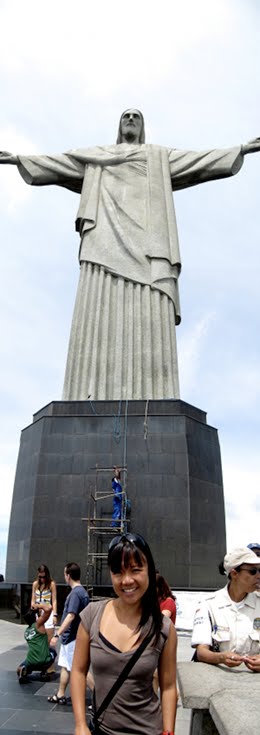
Christ the Redeemer
Rio de Janeiro, Brazil
Machu Picchu
A vertical panorama
We Speak Your Language
Recent Posts
~~ GO ~~
Excerpt from Visa Ad:
"It's one tiny, two-letter word that makes amazing things happen. GO is action. it's the spark that starts the flame that sets everything in motion. GO gets us to try things we've always wanted to try. GO keeps us going no matter what life throws our way. GO reminds us it's a big beautiful world out there, and it's time to make the most of it.... to get out there and play. to get out there and do. to get out there and experience all the incredible things life has to offer."
 Our friend Sue Anne commented on Facebook: "Oh i like this! A little lone fish struggling to keep up in the mad rush hour...kinda like me in HK!"
 "My name is Purple Peter, from Mars they don't come sweeter, I've come to see what's going on on Earth."
 Greetings from the future *deep bow* Take me to your leader
 Still a little off focus. But good enough for William Tell to aim and spear that apple (and, gulp, me)
 Making a plant look like a windmill
 Swirling some leaves around
 Forest colours take on a whimsical twist
 Taken while zooming out: Dan getting vacuumed out of this world and into another
 Taken while zooming in: Dan being surrounded by a quivering energy field
 A small unimpressive waterfall is transformed into a powerful gushing terror
 An ordinary pebble-filled stream now commands your attention