Our current time zone: GMT +8 (We're home in Singapore!)
Every year in December, cariocas (natives of Rio) gather at Lagoa Rodrigo, a lake sitting between Ipanema and Corcovado (where Christ The Redeemer stands), to take in the sight of a giant beautifully lit Christmas tree. The special feature of the tree is that it floats on the lake, creating a magical reflection of dazzling lights on the water surface. The idea was initiated by a private company, who designs and constructs it every year for the people of Rio. The great thing about this simple act of giving, is that everybody - whether fortunate enough to be born in the upper crust of society or living a harder life in a favela - has a Christmas tree to call their own. After staying in Rio for a week, we were convinced that we would be perfectly safe walking through Ipanema's streets at 10pm to the lake, and headed out to see the tree in its full sparkling glory.  O Christmas Tree, O Christmas Tree, why are you so far away and so difficult to photograph without a tripod?
  The tree was too far away so we created our own tree, right in front of us!
 Just to remind ourselves where we were....
 My Spanish teacher in Singapore said after seeing this pic, that 'Rio' is the name of a woman. So Dan had better watch what he writes...
 It was suppose to be a fire-breathing unicorn-capybara. But it looks like it's wearing a party hat and blowing on a party streamer instead. Well, the poor thing had a broken hind leg, so whatever makes it happy.
  We turned one into Rudolph by giving it a shiny nose and antlers. Dan made it happy by drawing in a proper hind leg for it, despite the original wooden leg being broken.
  Not quite the picture of an angel despite the wings and halo
 I tried to write "Christmas" in full but screwed up. Dan did a better job here. Merry Christmas to all our readers!
Rio de Janeiro truly deserves the title of The Marvelous City. The name Rio de Janeiro, meaning River of January, was given by the city's Portuguese founders, who sailed into Guanabara Bay on 1 January 1502 and mistook it for the delta of a huge river.The sprawling metropolis is home to rolling hills, tropical rainforest, samba parties, bossa nova, shiny modern buildings, favelas (slums, preferably referred to as poor urban neighbourhoods nowadays), world-famous landmarks and of course, the beautiful Copacabana and Ipanema beaches lined with beautiful bodies. Rio is also home to 14 million people (the population of Brazil is estimated to be a whopping 196 million, the 5th largest after China, India, USA and Indonesia.) But Rio's bad reputation for crime, drugs and violence precedes it's less famous moniker of La Ciudad Maravillosa. Anticipating limited seats and sky-high airfares over the Christmas and New Year period, we had bought our flights departing from Rio for Guatemala City in October. A few days later, we read news of people being killed on the streets as a result of violent acts, which involved the gunning down of a police helicopter and buses being set aflame. This came just days after Rio was awarded the opportunity to host the 2016 Olympic Games. We realised too late that maybe, it was a very very bad decision to fly out from Rio.We were seriously concerned whether we would make it out of Rio alive. We asked every traveller we met on the road whether they had been to Rio, and whether it was safe to go to. We received mixed reviews. Some scoffed and said that Rio was like any other city in South America - no more dangerous, no less dangerous. Others admitted that they didn't feel very secure walking the city streets.Chewing nervously on our fingernails, we prepared ourselves the best we could by:1. Timing our arrival in Rio for noon, which would give us plenty of time to locate our hostel in broad daylight;2. Conducting thorough online research on the safest areas in the city to stay;3. Booking a room at Rio Dolphin Inn, a guesthouse located right in Ipanema, reputedly one of the safest places to be in Rio. Previous guests also mentioned in their online reviews on Tripadvisor that they felt safe staying at the guesthouse and walking the area around it; 4. Checking with the guesthouse owner prior to our arrival on the best way to get from the bus terminal to the guesthouse and the expected taxi fare for the trip;5. Copying down word for word the description of the location of the guesthouse in Portuguese, as dictated by the owner, on a slip of paper, which we would hand to the taxi driver upon arrival at the Rio bus terminal.Unfortunately, we didn't expect the 18-hour bus ride from Florianopolis to turn into a 30-hour nightmare due to flooded roads and traffic gridlocks. We arrived in Rio just past midnight - thus screwing up Precaution No.1 big time.The taxi driver dropped us off at the given address in the rain. It turned out to be a cluster of houses behind a securely-locked iron gate. I realised that I had forgotten to note down the unit number of our guesthouse. Staring at the intercom device with house numbers from 1 to 12, I hazarded a guess and hit a number, only to be told by the voice emitting from the speakers, that there was no such unit known as Rio Dophin Inn and to try the hostel next door instead.Dragging our bags and the taxi driver along with us (whom we refused to pay until we confirmed that he had dropped us off at the correct place), we found out that the said hostel was Arpoador Beach House - not Rio Dolphin Inn. We asked if we could use their computer to search online for the phone number of Rio Dophin Inn, so that we could ask the owner of the inn for assistance. A large unsmiling lady who appeared to run the place refused to let us even step beyond the gate unless we paid 80 Reals (S$64) for a room at her hostel. It was 1 am. It was dark.It was raining. In a city famous for crime and violence. Things were happening in a language that we couldn't understand, much less speak.
Dan's foot was swollen and hurting from a mild gout attack. The cab driver was insisting that we just stay at the (wrong) hostel and kept demanding for payment. Our bags were still in the cab. The only English-speaking staff at the hostel was chiding us for stupidly paying a US$330 deposit in advance for our room at Rio Dolphin, which we were now going to lose, especially since the place might not even exist.
The fat unsmiling lady was threatening to close the door on us and leave us out on the street. This was our welcome to the so-called Marvelous City. Hip.Hip.Hooray.Left with no other choice, we resignedly agreed to pay for a night at Arpoador Beach House. I insisted on borrowing their phone to call John and Nina, our hosts at Rio Dolphin (who had been so warm and friendly over email), to inform them that we would not be turning up that night, lest they wait up the whole night for us. A friendly staff, afraid that Fat Unsmiling Lady would skin him alive for letting us use the hostel phone, called Rio Dophin from his personal cellphone.In less than 3 minutes, John from Rio Dophin arrived at Arpoador Beach House to collect us. We explained our plight and he marched up to the counter and berated Fat Unsmiling Lady (who was hiding behind the wall while letting her poor staff front the situation) for her utterly inhospitable attitude towards visitors to her city. She insisted that we were now her guests as we had filled up the registration form (as if we had any choice! Thankfully, I used fake particulars) and wanted to charge us 80 Reals, whether we were staying or not. I asked if we could just pay for the use of the computer. Yes, she said - 80 Reals.After more heated exchanges in Portuguese, we escaped from the clutches of Arpoador Beach House after paying 10 Reals (S$8!!!) for 1 minute on their computer, and hurriedly trotted out behind John our saviour, and over to Rio Dophin next door.Frayed nerves soothed over glasses of grape juice which John kindly offered, we were shown to our room. It felt as if we had emerged from a trying 30-hour ordeal and into heaven.  Before this, I had never thought of heaven in the form of a cosy little room
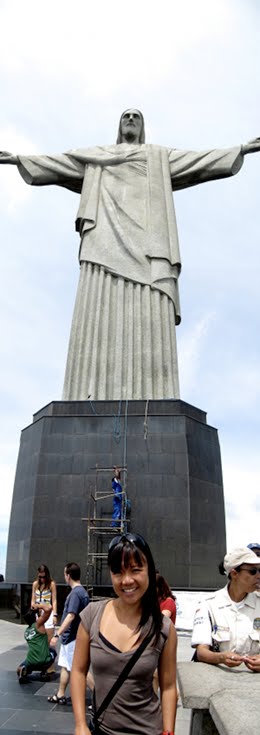
 View of a favela while driving up Corcovado hill to see Christ the Redeemer
 Lagoa Rodrigo de Freitas - the lake where rowing and canoeing events will be held for the 2016 Olympic Games. Beyond that is Ipanema beach.
  From left to right: Guanabara Bay, the iconic Sugarloaf Mountain and Copacabana beach. Marathon swimming, triathlon and beach volleyball events will be held Copacabana for the 2016 Olympic Games.
  The Maracana Stadium, as seen from helicopter (guess who was the lucky man who went up!)
 Taking photos and eating ice-cream outside the stadium, cos we didn't want to pay 20 Reals (S$16) each to go onto the pitch.
  Basking in the presence of famous footballers
 GGGGGOOOOOOAAAAAALLLLLLLLLLLLLLLLLLL *yell continuously for 30 seconds without taking a breath* (that's how commentators here do it)
 Aspiring samba dancer... real sexy eh.
  Imagining a standing ovation for our couple dance
 It exists!
 Beautifully, naturally lit
 The 4 stained glass windows stretch high up to meet at the cross-shaped apex
 Light & Shadow
Happy with our visit to so many of the city's icons in one morning, we zipped off to Rio Sul, one of the bigger shopping malls in the city. Brazil is amazingly modern in many aspects. Compared to its South American neighbours, it has the best paved roads that we have experienced on this continent. Cross-country travel is facilitated by comfortable double-decker buses, fitted out with free WiFi (but whether the WiFi actually works or not is another issue altogether.) All public toilets are equipped with toilet paper (hooray!) I felt like a silly country bumpkin bringing my personal toilet roll (a necessity in all other countries in South America) around in Brazil.
Together with Leblon Shopping, Rio Sul is the most modern indoor shopping mall that we have been to in South America and both malls are on par with many of Singapore's shopping centres - clean, air-conditioned, presence of departmental stores and brand-name fashion outlets, cineplexes, foodcourt, etc. We spent a rainy Sunday afternoon at Leblon taking in the Christmas decorations and jingles, window shopping, exploring the food court and just basking in the festive atmosphere and air-conditioned comfort. We even caught 2012 on big screen - popcorn and all! It was our first visit to a cinema in 9 months. I had apparently forgotten how to slip a huge cup of Coke back into the cup-holder positioned on the arm-rest after sipping from the straw - and spilled a good part of the icy contents of the fat 1-litre cup onto Dan's lap. Ooops.
However, our malls back home are no match for Rio's when it comes to one aspect - toilets. Here, there are 4 types of restrooms - Gents, Ladies, Family (where parent-child pairs of mix gender can enter) and Baby (equipped with changing tables.) The Ladies restroom (which, of course, was the only one I visited) was incredibly clean. The floors and sink counters were dry; the liquid soap dispensers actually had soap in them and worked; toilet paper, paper towels and electric hand-dryers were provided; and best of all - it didn't stink. There was even a waiting area comprising a small couch and a couple of arm chairs in the restroom - something I've only seen back home in the restrooms at Changi Airport Terminal 3 and swanky hotels. Unless the standard of restrooms in Singapore shopping malls has been raised with the birth of Somerset 313 and Ion Orchard (which I have yet to visit), I'll still be trying my darnedest to avoid visiting public toilets back home.
 A big Christmas tree at Leblon Shopping standing in for the whole of Orchard Road for us this year
P.S. We have yet to see any flaming buses on the streets *cross fingers* Regarding the incidents of buses being set alight in October, John told us that the arson was carried out by rebels with a heart. They had waited until the bus reached its final destination and for all the passengers (and the driver) to alight before setting the empty bus afire. That actually sounded really comforting to us!
Sorry for the long silence on the blog. My brain is like a traffic jam these days. It keeps getting stuck. Ah well, there are good days and bad days, right?
Now, on to the story! :)---------------------------------------------
Of the 5 glorious days in Florianopolis, we spent 1 day sleeping in, 3 at the beach, and 1 day looking for a way to get to Rio de Janeiro.It did not look like we had many choices. Either pay about 200+ Reals per person (1 Real is about SGD 0.80) for a 20-22 hour bus ride, or pay 400+ Reals and fly.Well... the Asia Travel Tips article DID mention that connectivity of Santa Catarina is a main obstacle for greater tourism numbers. Now we know why. We were getting quite disheartened with our options when I spotted this little travel agency and decided to just check with them for options and prices.And it was a good thing we did. Because we were given an option to purchase bus tickets to Sao Paulo for about 85 Reals per person. From Sao Paulo, we could get cheap bus tickets to Rio, generally at about 70 Reals. That translated to a savings of at least 70 Reals per person, enough for us to immediately put our money on the table and say, "We'll do it!".Oh, and being able to visit a real restroom in Sao Paulo instead of using the same toilet as 50 other people for 20 hours was quite a deal-sealer too!So we were quite happy to board the 5pm bus from Florianopolis, to arrive at Sao Paulo by 7am the next morning before hopping to the next available bus for another 6 hour ride to Rio de Janeiro.What we didn't contend with was heavy rain the night we were on the bus (I stayed awake as long as I could, hoping to see another spectacular lightning display, but this particular storm was pretty boring).When we forced our eyeshit-laden eyes open the next morning, we found a bright sky signaling to us that it was way past 6am. Sitting up, we reassured ourselves that we did not miss our stop, and the bus would not be depositing us into the Amazon River instead of the January River (yeah... thats what Rio de Janeiro is called).Buggeration! The on-off rains over the night have caused a massive, massive traffic jam on the roads! Yeah, those recent flood at Bukit Timah a few weeks back was peanuts compared to this. An entire city, gridlocked
 Quitters! For shame!
 More quitters!
 Bystanders waiting to see if anyone stalls. This is called "schadenfreude"
 Motorcyclist had to gun his engine all the way to prevent water from getting into the exhaust
 The wife just had to show off her pretty, dry feet
 Let's play Hide-and-Seek. You can hide anywhere amongst the buildings, but not underwater, okay?
 Practicing on a waterlogged pitch for World Cup 2016
 O Christmas Tree, O Christmas Tree, why are you so far away and so difficult to photograph without a tripod?
  The tree was too far away so we created our own tree, right in front of us!
 Just to remind ourselves where we were....
 My Spanish teacher in Singapore said after seeing this pic, that 'Rio' is the name of a woman. So Dan had better watch what he writes...
 It was suppose to be a fire-breathing unicorn-capybara. But it looks like it's wearing a party hat and blowing on a party streamer instead. Well, the poor thing had a broken hind leg, so whatever makes it happy.
  We turned one into Rudolph by giving it a shiny nose and antlers. Dan made it happy by drawing in a proper hind leg for it, despite the original wooden leg being broken.
  Not quite the picture of an angel despite the wings and halo
 I tried to write "Christmas" in full but screwed up. Dan did a better job here. Merry Christmas to all our readers!